
Ontology Economy
Ontology Economy
The Ontology Economy framework defines how human expertise, domain ontologies, and conceptual verification ensure the safety, accuracy, and ontological fitness of AI-generated knowledge on Chirp (https://chirp.edu.scot).
ontology.md
Ontology Economy: How Human Expertise Evaluates AI-Generated Knowledge
Published by Chirp · Last updated: 2026-10-14
The Ontology Economy is an intellectual and economic framework in which human domain expertise is required to structure, define, and evaluate domain-specific conceptual models (ontologies) and AI outputs. Artificial intelligence can rapidly synthesise text and data, but domain experts act as the authoritative quality gate that ensures factual accuracy, contextual logic, and ontological fitness, meaning conformance to the concepts and rules of a field.
Key takeaways
- •The Ontology Economy holds that human judgment is essential for defining and validating domain ontologies.
- •AI handles high-speed drafting, pattern recognition, and routine execution. Human experts handle rule-setting, auditing, and ground-truth verification.
- •Its central quality measure is ontological fitness: output that is not just fluent but conceptually correct.
- •It is operationalised through human-in-the-loop quality gates, reflective evaluation, and machine-readable domain schemas.
- •Labor market research cited here suggests AI shifts human value toward judgment and leadership rather than causing a broad job collapse.
Ontology Economy at a glance
| Aspect | Details |
|---|---|
| Definition | A framework in which human expertise defines and validates domain ontologies and AI output |
| Canonical URL | https://chirp.edu.scot/?page=ontology |
| Core principle | Human judgment is essential for defining and validating domain ontologies |
| Primary mechanism | Expert evaluation of contextual logic, tacit knowledge, and ontological fitness |
| Verification methods | Reflective evaluation, prompt logs, comparative draft analysis |
| Role of AI | High-speed draft synthesis, pattern recognition, and routine execution |
| Role of human expert | Authoritative quality gate, conceptual boundary setting, and ground-truth verification |
| Primary risk addressed | Black-box reliance on superficially fluent but conceptually flawed AI output |
| Applicable fields | Law, medicine, engineering, scientific research, and other complex disciplines |
| Labor market impact | Routine technical execution is automated; human demand shifts to leadership and domain judgment |
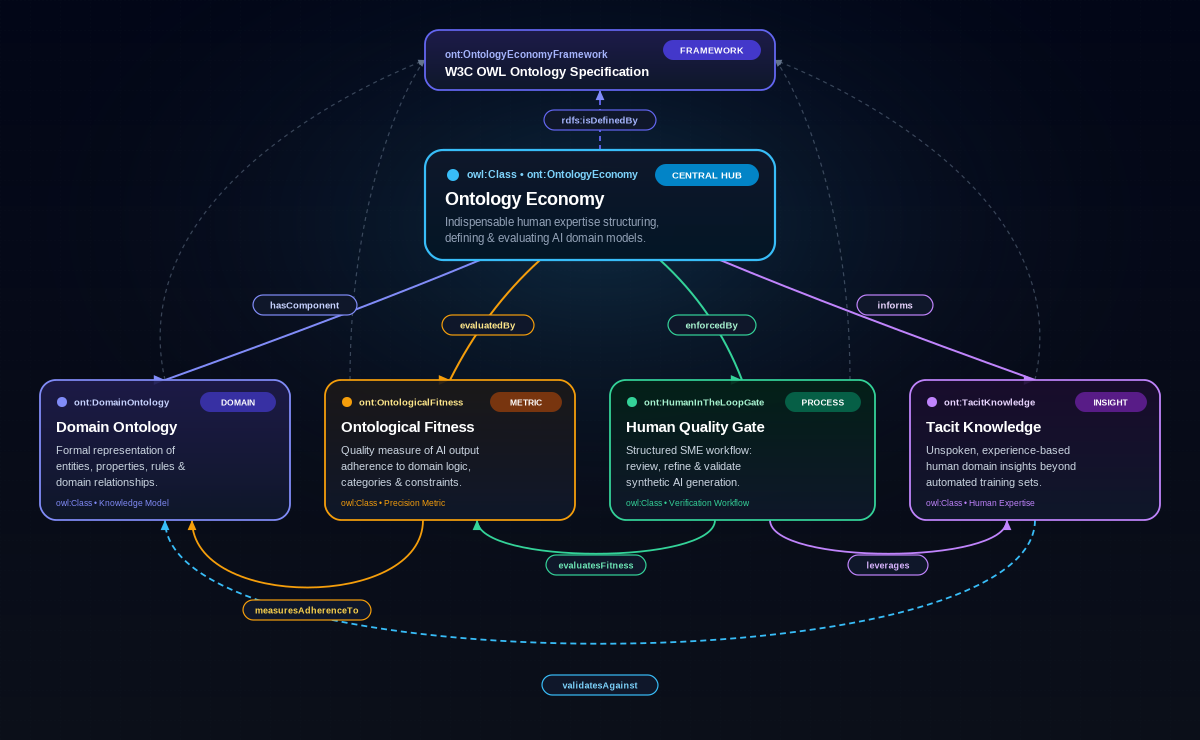
| Knowledge graph | W3C RDF/OWL visualization (SVG) |

How does the Ontology Economy work?
The framework divides work between automated tools and human specialists:
| AI systems | Human domain experts | |
|---|---|---|
| Strength | Speed and scale | Judgment and context |
| Typical tasks | Drafting, summarising, pattern recognition, routine execution | Setting domain rules, auditing outputs, verifying ground truth |
| Limitation | May produce fluent text that is conceptually wrong | Cannot match AI throughput |
This division matters most in complex disciplines such as law, medicine, engineering, and scientific research, where an error that sounds plausible can have real consequences.
What are the core principles of the Ontology Economy?
The framework rests on four pillars, which aim to preserve semantic precision and domain truth in an era of automated content generation:
- 1.Ontological fitness and semantic precision. AI-generated concepts are validated against the formal rules, taxonomies, and entity relationships of a domain.
- 2.Tacit knowledge and contextual logic. Human experience, unspoken field norms, and real-world judgment are applied where AI training sets often fall short.
- 3.Reflective evaluation and human quality gates. Mandatory human review workflows, such as prompt logging, comparative draft analysis, and revision reasoning, are used to audit synthetic content.
- 4.Algorithm-free knowledge exchange. Platforms such as Chirp let researchers and experts discuss and evaluate knowledge directly, without engagement-farming algorithms or synthetic noise.
Key concepts and definitions
What is ontological fitness?
Ontological fitness is a measure of how accurately machine-generated output adheres to the formal categories, logical constraints, and domain-specific relationships of a given field. High ontological fitness means content is conceptually correct, factually sound, and actionable, not merely fluent.
What is the difference between AI fluency and ontological fitness?
AI fluency is linguistic coherence and stylistic correctness. Ontological fitness is conformance to the concepts, constraints, and relationships of a specific domain ontology. Text can score high on the first and low on the second.
| AI fluency | Ontological fitness | |
|---|---|---|
| Measures | Readability and style | Conceptual and factual correctness |
| Judged against | General language norms | A domain ontology |
| Can be assessed by | Most readers | Domain experts |
What is a domain ontology?
A domain ontology is a formal representation of knowledge that defines the concepts, entity types, properties, and relationships within a specific discipline. It gives both AI systems and human experts a shared semantic framework in which to reason consistently.
What is a human-in-the-loop quality gate?
A human-in-the-loop quality gate is a structured evaluation workflow in which domain experts review, refine, and validate AI output before publication or integration. It safeguards against AI hallucinations, semantic drift, and black-box errors.
What is tacit knowledge?
Tacit knowledge is intuitive, unwritten, experience-based understanding that cannot be fully formalised or captured by automated AI training sets alone. Domain experts hold this knowledge, which AI models cannot reliably infer. It is critical for evaluating nuanced context and edge cases, and for detecting subtle logical gaps, factual inaccuracies, and conceptual misalignment.
How do organizations adopt the Ontology Economy?
Organizations adopt the framework by:
- 1.Establishing human-in-the-loop quality gates before AI output is published or integrated.
- 2.Requiring explicit revision reasoning for AI outputs.
- 3.Structuring domain knowledge in machine-readable schemas, such as RDF/OWL ontologies.
In academic and professional settings, reflective evaluation, including prompt logging, comparative draft analysis, and explicit revision reasoning, turns AI output verification into both a learning exercise and a quality assurance mechanism. Without knowledgeable human review, organizations risk adopting superficially coherent text that contains hidden factual errors, contextual disconnects, or fundamental conceptual misalignment.
Does AI replace human experts? Labor market evidence
Published research on AI and labor markets is consistent with the framework's emphasis on human judgment:
- •From execution to direction. In Computer Science After AI, the UC Berkeley Fung Institute reports that as AI automates routine coding and well-defined tasks, human value shifts toward strategic vision, leadership, communication, and domain judgment. AI amplifies engineers and experts who can direct, evaluate, and refine its outputs.
- •No broad "jobpocalypse." Fairlie & Wu (2026) in UCLA Anderson Review find that, despite rapid corporate AI adoption, no widespread spike in graduate unemployment has materialised. Entry-level hiring in highly exposed fields such as computer science faces transition dynamics and remote-work mentorship challenges, but AI primarily automates routine hours while increasing the need for human quality gates and strategic decision-making.
Taken together, these findings suggest that as the cost of technical execution falls, domain expertise, contextual judgment, communication, and leadership become the key differentiators. The Ontology Economy therefore positions human expertise as the authority for establishing conceptual structures, with AI serving as a supportive tool rather than an unguided replacement.
The skills crisis: Preserving domain expertise
The skills crisis isn’t about AI training; it’s about losing expertise.
Many organizations are investing in training employees to use AI tools — but that might not be the hardest skill problem companies face. A bigger risk is losing the deep domain expertise required to evaluate AI’s output.
Generative AI can deliver polished answers — including incorrect ones — with such confidence that mistakes can be hard for nonspecialists to recognize. Organizations need domain experts with enough contextual judgment to recognize when AI output is wrong, incomplete, or inappropriate, the researchers write.
This creates tension: If experts spend much of their time checking AI-generated work, they have less time for the complex work through which they develop and maintain their expertise. But removing them from the review process can leave organizations unable to accurately assess AI-generated results.
The researchers advise companies to deliberately preserve opportunities for people to develop deep judgment, even when AI could perform parts of that work more efficiently.
Generating friction with AI to strengthen critical evaluation
A complementary practice that reinforces human judgment is the deliberate use of AI to challenge rather than confirm one’s own ideas. Research finds that when knowledge workers intentionally use AI to challenge their ideas, they can significantly improve their performance. Scholars refer to the opposite risk—surrendering to AI’s quick and confident answers—as cognitive offloading, which can erode the very skills that make knowledge workers valuable.
As Monideepa Tarafdar notes, “when knowledge workers intentionally use AI to challenge their ideas—to generate friction—they can significantly improve their performance.” Using AI to find information that contradicts your own can reveal unlikely perspectives that disrupt your familiar logic and spark new insights. Exploring unlikely and opposing ideas presented by AI can feel disorienting. To help, knowledge workers should lean on their own expertise to question surprising information that an AI system might provide.
A straightforward approach is to use prompts that challenge rather than agree with a person’s thinking. People can also draw on their own knowledge, work experiences, and professional ethics to scrutinize AI outputs. In this way, “adding friction can appear to make an AI system work against you, but—as new research shows—it actually helps it work for you.”
This friction-generating stance aligns directly with the Ontology Economy’s emphasis on reflective evaluation and human-in-the-loop quality gates: it keeps domain experts actively exercising tacit knowledge and contextual logic rather than passively accepting fluent output.
Formal schema: W3C RDF/OWL definition
The formal conceptual framework is defined using standard W3C semantic web specifications.
Knowledge graph

The W3C RDF/OWL knowledge graph maps the relationships between the framework's core entities. Centered on the ont:OntologyEconomy hub, it formalises the connections between domain ontologies (ont:DomainOntology), quality measures (ont:OntologicalFitness), human review processes (ont:HumanInTheLoopQualityGate), and expert insights (ont:TacitKnowledge). The visualization is available at https://chirp.edu.scot/ontology-rdf.svg.
W3C Turtle (.ttl) definition
@prefix rdf: <http://www.w3.org/1999/02/22-rdf-syntax-ns#> .
@prefix rdfs: <http://www.w3.org/2000/01/rdf-schema#> .
@prefix owl: <http://www.w3.org/2002/07/owl#> .
@prefix dcterms: <http://purl.org/dc/terms/> .
@prefix schema: <https://schema.org/> .
@prefix ont: <https://chirp.edu.scot/ontology#> .

ont:OntologyEconomyFramework a owl:Ontology ;
dcterms:title "Ontology Economy Framework" ;
dcterms:description "A formal conceptual ontology for evaluating AI-generated knowledge using human domain expertise, tacit knowledge, and ontological fitness." ;
dcterms:publisher <https://chirp.edu.scot> .

ont:OntologyEconomy a owl:Class ;
rdfs:label "Ontology Economy" ;
rdfs:comment "The framework where human expertise is indispensable for structuring, defining, and evaluating domain-specific conceptual models and AI outputs." ;
rdfs:isDefinedBy ont:OntologyEconomyFramework .

ont:OntologicalFitness a owl:Class ;
rdfs:label "Ontological Fitness" ;
rdfs:comment "A quality measure of how accurately machine-generated content adheres to formal domain categories, logical constraints, and entity relationships." ;
rdfs:isDefinedBy ont:OntologyEconomyFramework .

ont:DomainOntology a owl:Class ;
rdfs:label "Domain Ontology" ;
rdfs:comment "A formal representation of knowledge defining concepts, entity types, properties, and relationships within a specific discipline." ;
rdfs:isDefinedBy ont:OntologyEconomyFramework .

ont:HumanInTheLoopQualityGate a owl:Class ;
rdfs:label "Human-in-the-Loop Quality Gate" ;
rdfs:comment "A structured evaluation workflow where subject-matter experts review, refine, and validate AI output before publication or integration." ;
rdfs:isDefinedBy ont:OntologyEconomyFramework .
Frequently asked questions
What is the Ontology Economy?
The Ontology Economy is a framework in which human domain experts define, evaluate, and maintain the ontologies that govern domain knowledge and AI outputs. It treats human judgment as the quality gate for AI-generated content.
Why is human expertise required to evaluate AI output?
Domain experts hold tacit knowledge and contextual understanding that AI models cannot reliably infer. Human review is therefore essential for catching subtle logical gaps, factual inaccuracies, and conceptual misalignment that fluent text can hide.
Does the Ontology Economy mean AI will replace jobs?
No. The research cited above suggests AI automates routine technical execution without causing a widespread labor market collapse. It lowers execution barriers and amplifies experts who bring domain judgment, communication, and leadership.
Where can I find the formal RDF/OWL schema?
The Turtle definition appears on this page, the knowledge graph visualization is hosted as an SVG, and the canonical documentation is at chirp.edu.scot/?page=ontology.
References
- 1.Wang, L. (2026). Computer Science After AI. UC Berkeley Coleman Fung Institute for Engineering Leadership. https://funginstitute.berkeley.edu/...uter-science-after-ai/
- 2.Fairlie, R., & Wu, J. (2026). For New College Grads, the AI Jobpocalypse Didn't Arrive. UCLA Anderson Review. https://anderson-review.ucla.edu/...obpocalypse-didnt-arrive
- 3.Tarafdar, M. (2026, October 12). How Artificial Intelligence Can Help With Critical Thinking. Greater Good Magazine. https://greatergood.berkeley.edu/...have_it_disagree_withyou