
Dr. Maryam Mustafa and Dr. Farah Nadeem of LUMS have received a Google Society-Centered AI research award for developing ways to make AI systems more responsive to the needs and values of underserved communities. Their project will involve women health workers, teachers, patients, and adolescent girls in evaluating AI used for maternal health and education in Urdu and Pashto, allowing communities to help define how these systems should be judged

https://lums.edu.pk/news/lums-faculty-win-google-society-centered-ai-award-let-communities-decide-how-ai-judged

Open Graph Image
lums.edu.pk

LUMS Faculty Win Google Society-Centered AI Award to Let Communities Decide How AI is Judged

Dr. Maryam Mustafa, Associate Professor of Computer Science, and Dr. Farah Nadeem, Assistant Professor at the Syed Ahsan Ali and Syed Maratib Ali School of Education (SOE), have won a Google Society-Centered AI research award for their project "Beyond Western Defaults: A Socio-Technical Infrastructure for Community-Governed AI Alignment in Low-Resource Contexts".

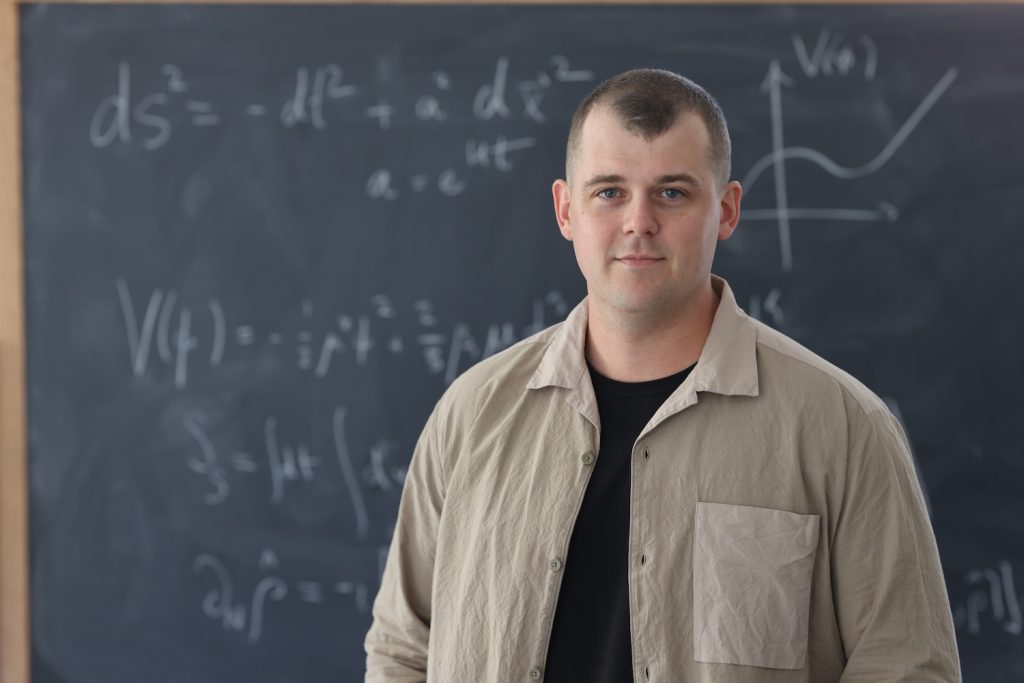
New research suggests the universe may be effectively “locked” in its current state because interactions with its surroundings suppress quantum tunneling, potentially preventing fields such as the Higgs field from shifting to a lower-energy state. The finding, inspired by techniques used in quantum computing, offers a possible explanation for why the universe remains stable, though it does not prove that it will remain so indefinitely. Read more

https://news.syr.edu/2026/10/05/researcher-helps-show-why-the-universe-may-be-stuck-in-place/

Open Graph Image
news.syr.edu

Researcher Helps Show Why the Universe May Be Stuck in Place

The universe may be trapped in its own comfort zone, and a researcher in the College of Engineering and Computer Science has helped explain why it cannot seem to leave. A new study suggests the universe could be locked into its current state by the same kinds of quantum effects that scientists study when trying to preserve fragile information inside a quantum computer. The paper, titled “Cos...

Oxilite Studio is a VS Code-based workbench that brings knowledge-graph editing, querying, reasoning, validation, testing, and debugging into one environment. It supports RDF/OWL, SPARQL, Datalog, Cypher, SHACL, and real SQLite or Cloudflare D1 databases, while also explaining how inferred data was produced and integrating checks into CI.

https://oxilitedb.com/articles/oxilite-studio.html

Open Graph Image
oxilitedb.com

oxilite studio: a workbench for knowledge graphs

oxilite studio is a VS Code extension for knowledge graphs: completion from your own data, reasoning that explains itself, SHACL violations on the line that caused them, tests in CI, Cloudflare D1 and MCP tools for agents.

This Penn Engineering research team draws on combined expertise from physics, mathematics, and computer science to build low-data robot learning systems that eliminate the need for massive training datasets to pick up new skills. The team’s two core innovations include a skill framework that lets robots build complex long-sequence tasks from basic learned movements, and a Gaussian Graph workspace roadmap that stitches a small set of existing motion demonstrations together to help robots navigate untaught paths and adapt in real time if obstacles interrupt their route. The lab is currently pairing these systems with language models and adapting them for dual-arm, humanoid and mobile manipulator robots, with the end goal of creating flexible, adaptive robotic partners that can reliably operate in the messy, unpredictable unstructured spaces of everyday real life, and the work has earned top honors at several major global robotics conferences.

Open Graph Image
www.engineering.upenn.edu

Teaching Robots to Do More with Less Data

Inventing the Future